The 'Constantinian Question'
- ajpott

- Jul 15, 2022
- 8 min read
I am happy to return to this blog after focusing mostly on the completion of my book, Power and Rhetoric in the Ecclesiastical Correspondence of Constantine the Great (Routledge, 2022). The book may be pre-ordered here, here, here, or here; it is scheduled for released at the end of November this year.
One of the questions I'm asked most frequently since I started this research about nine years ago is: Do you think Constantine was a real Christian?
This is what historians call the ‘Constantinian question’, and for centuries it interested writers reflecting on this emperor and his reign just as it continues to intrigue the general public today. Practically ever since Constantine’s lifetime until about the mid-20th century, perspectives have shifted somewhere between radically different portrayals of the emperor’s relationship to Christianity. For that reason, it is a question that is still worth at least some attention although there are good reasons that scholars have moved on.

Christian authors like Lactantius and Eusebius of Caesarea, both of whom wrote during Constantine’s reign, saw him as playing a leading role in God’s plan.[1] Non-Christians, like Constantine’s nephew Julian (r. 361-363, remembered as ‘Julian the Apostate’ because of an apparent conversion from Christianity) and the early 6th century writer Zosimus, described Constantine as a foolish, pleasure-loving, oath-breaker who used Christianity for his own selfish purposes.[2] Throughout subsequent centuries, Christian writers tended to be more positive about Constantine while non-Christians were frequently hostile.[3]
Then, divergent views appeared within Christendom itself. Constantine’s memory was evoked throughout the medieval period in order to strengthen the contrary claims to earthly power of both Christian bishops and Christian monarchs. But following the 16th century Protestant Reformation, some Christian attitudes took a drastic turn. Those associated with the Anabaptist movement, a radical Protestant group that (along with emphasizing the necessity of adult baptism) rejected the traditional mutual support of church and government, held Constantine at least indirectly responsible for a ‘fall of the church’ in the fourth century.[4]Generally speaking, Western evangelicals tend largely to accept this opinion although it might perhaps be mediated to them from other sources at second- or even third-hand.[5]

Two writers in the 18th and 19th centuries (Edward Gibbon and Jacob Burckhardt, respectively) proved highly influential for later modern perspectives on Constantine. Gibbon (English author of History of the Decline and Fall of the Roman Empire, published in six volumes between 1776-1788) believed the growth of Christianity partially responsible for the empire’s ‘decline and fall’, though his take on Constantine’s conversion is fairly nuanced: ‘As real virtue is sometimes excited by undeserved applause, the specious piety of Constantine, if at first it was only specious, might gradually, by the influence of praise, of habit, and of example, be matured into serious faith and fervent devotion’.[6] In other words, Gibbon was in little doubt that Constantine was first attracted to Christianity because the emperor perceived that its structures and teachings might serve his imperial ambitions; however, continued exposure to Christianity in a cultural environment that took the supernatural for granted probably did have an actual impact on him.
German scholar Jacob Burckhardt famously minced no words in the mid-19th century in describing his negative interpretation of Constantine: ‘… in a genius driven without surcease by ambition and love of power there can be no question of Christianity and paganism, of conscious religiosity or irreligiosity; such a man is essentially unreligious, even if he pictures himself standing in the midst of a churchly community’.[7] For Burckhardt, Constantine was motivated primarily by political self-interest and could therefore never be viewed as a genuine Christian, regardless of what the emperor or anyone else might say to the contrary.
Early in the 20th century, Norman Baynes directly opposed Burckhardt’s conclusions in a published lecture.[8] Baynes asserted the sincerity of Constantine’s conversion and even suggested that this emperor’s being honored in death as a ‘thirteenth apostle’ was entirely appropriate. Perhaps in reaction to the more radical interpretations of both Burckhardt and Baynes, moderation began to appear between the 1930s and 1960s.[9] The work of scholars like Timothy Barnes, Harold Drake, Noel Lenski, Charles Odahl, and Jonathan Bardill each present even more nuanced, if not always even-handed, portraits of Constantine.[10]
In 2010, Reformed evangelical theologian Peter Leithart published a book provocatively titled Defending Constantine, which challenged Anabaptist views of Constantine’s importance to Christianity on both historical and theological grounds. Responses to Leithart from the Anabaptist perspective were offered in the edited volume Constantine Revisited. Those interested in either or both theological and historical reflection will find these two volumes very much worth their time, although their primary value is for theologians.[11]
Historians, though, no longer really concern themselves with the ‘Constantinian question’. Kate Cooper, for instance, writes: ‘The false division between “politics” and “religion” has diverted scholarship into the dead-end of arguing over an anachronistic question, whether or not Constantine was a true believer’.[12] Our modern tendency to conceptually separate ‘politics’ and ‘religion’ is a ‘false’ one, because this is not how people in the ancient world thought. For them, society was a political and a religious reality at one and the same time. Roman magistrates and later emperors were religious as well as civil authorities, and the empire itself was a religious institution as much as a political entity. The so-called ‘Constantinian question’ is ‘anachronistic’ because it commits the error of failing to interpret the past on its own terms, instead forcing modern ideas onto an ancient culture that could not have conceived of (much less shared) a separation of ‘religious’ and ‘non-religious’.
So when the question is presented to me—‘Do you believe that Constantine was a genuine Christian’?—it is difficult to give the expected ‘yes’ or ‘no’ answer. How can I look at anyone in my own time and place in order to discern with any kind of certainty the authenticity of their Christian profession, the ‘health’ of his or her spiritual life, or even the orthodoxy of their beliefs? For this reason alone, I could never provide anyone with a clearly stated opinion about Constantine in these areas. Additionally, Constantine himself seems to have deliberately publicized his religious allegiance in rather ambiguous terms (which is what Bardill’s work emphasizes). It is not necessarily that he tried to present himself as a pagan to one group, while attempting to be accepted as a Christian among Christians. Rather, his statues, coins, and inscriptions, for example, were designed in ways that leave the viewer—Christian or pagan—free to read their own perspectives into such imagery.
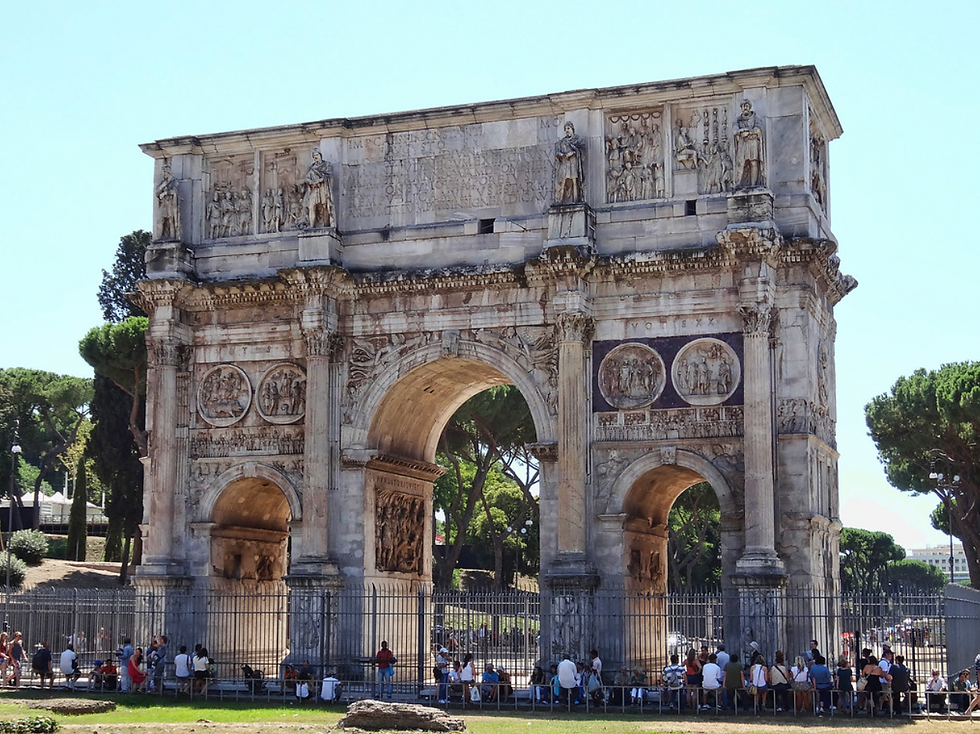
The ambiguity of Constantine’s public self-presentation notwithstanding, there is plenty of evidence suggesting that he indeed genuinely believed himself to be a Christian. There is no surviving indication that his Christian subjects did not by and large accept (or at least appeal to) him as one of their own. When writing to Christian bishops, he regularly referred to them as his ‘beloved brothers’. He described a change in his life in terms that ought to resonate to some extent with any modern evangelical: ‘For there were initially in me many obvious defects in righteousness … But Almighty God who sits in the vantage-point of heaven bestowed upon me what I did not deserve …’.[13] He took the time and effort throughout his reign to address various divisions among Christians, presided over the Council of Nicaea in 325, and was known to maintain an interest in Christian theology (a single speech, The Oration to the Assembly of the Saints, survives to demonstrate this). Some of his legislation indicates a concern for the poor that is quite unusual for an emperor. He not only ceased the persecution of Christians in his domains, but restored their corporately-owned property to them at public expense, and gave vast amounts of money to bishops for building or re-modeling churches and ensuring that they had everything needed in order to conduct Christian worship.
At the same time, some of the evidence is troubling when measured against some standards of what might constitute a ‘true Christian’. One of the most glaring dark stains on his record is the mysterious deaths of his oldest son Crispus and second wife Fausta in 326. Exactly what happened and why remains unknown for certain, but Constantine’s responsibility for both of these deaths cannot be ruled out and even seems likely. He also wrote about the Jews, particularly in a letter to the churches concerning Nicaea’s decision on when Easter should be celebrated, in harsh terms that would make any modern reader cringe uncomfortably.
Constantine is most often remembered as ‘the first Christian emperor’. I accept, with most modern scholars, that he certainly believed he was a Christian and that there is plenty of evidence to support such a claim. I also believe that Constantine was, before he was anything else, a very typical Roman emperor in many ways. This was not really a choice he had to make—to be an emperor or to be a Christian. He could be and, in my opinion, was both at the same time. But however genuine or deeply-felt his Christian beliefs may very well have been, he never forgot (or allowed anyone else to!) that he was the emperor.
But was he a ‘good Christian’? Were his beliefs, to the extent that these can be known, theologically precise in their orthodoxy or lean more toward heresy? These questions cannot really be answered. When they are considered carefully within their context, they are really beside the point. I conclude from all of this that Constantine, rather than being remembered as the ’first Christian emperor’, ought to be understood perhaps as the first emperor who professed or happened to be a Christian.

[All images are public domain or creative commons]
[1] For English translations of these works, see Lactantius, De Mortibus Persecutorum (trans. J.L. Creed; Oxford: Clarendon Press, 1985) and Eusebius of Caesarea, The History of the Church: A New Translation (trans. Jeremy M. Schott; Oakland: University of California Press, 2019). Eusebius also wrote another relevant work shortly after Constantine’s death, called The Life of Constantine (trans. Averil Cameron and Stuart G. Hall; Oxford: Clarendon Press, 1999). [2] See Julian, ‘The Caesars’ in Julian: Vol. II (Loeb Classical Library; trans. Wilmer C. Wright; Cambridge: Harvard University Press, 1913) and Zosimus, New History (trans. Ronald T. Ridley; Leiden: Brill, 1982). [3] Raymond Van Dam, Remembering Constantine at the Milvian Bridge (Cambridge: Cambridge University Press, 2011), 33-34. [4] See The Complete Writings of Menno Simons c. 1496-1561 (trans. Leonard Verduin; ed. J.C. Wenger; Repr. Scottsdale: Herald Press, 1984); cf. Walter Klaasen, ‘The Anabaptist Critique of Constantinian Christendom’, Mennonite Quarterly Review 55:3 (1981), 218-230. [5] For instance, see 18th-century Methodist founder John Wesley’s sermon ‘The Mystery of Iniquity’ (1783): http://wesley.nnu.edu/john-wesley/the-sermons-of-john-wesley-1872-edition/sermon-61-the-mystery-of-iniquity. Accessed online: 9 July 2022. See also various writings by Methodist ethics scholar Stanley Hauerwas, particularly Stanley Hauerwas and William H. Willimon, Resident Aliens: Life in the Christian Colony (exp. 25th anniv. edn; Nashville: Abingdon Press, 2014), which has been a popular text for undergraduate evangelical theology students. Among Hauerwas’ influences is the late Mennonite theologian John Howard Yoder, for whose Anabaptist-influenced views see John Howard Yoder, The Politics of Jesus (2nd edn.; Grand Rapids: Eerdmans, 1994). [6] Edward Gibbon, The History of the Decline and Fall of the Roman Empire, Vol. I-II (ed. David Womersley; London: Penguin, 1994): for this quotation, see Vol. 1, ch. 20. [7] Jacob Burckhardt, The Age of Constantine the Great (trans. Moses Hadas; New York: Pantheon, 1949 [1853]), 292. [8] Norman H. Baynes, Constantine the Great and the Christian Church: 1929 Raleigh Lecture on History (2nd edn.; London: Oxford University Press, 1931). [9] M. Cary and H.H. Scullard, A History of Rome Down to the Reign of Constantine (3rd edn.; London: MacMillan, 1975 [1935]); Hans Lietzmann, A History of the Early Church, Vol. III: From Constantine to Julian (trans. Bertram Lee Wolf; 2nd. rev. edn. London: Lutterworth Press, 1953); A.H.M. Jones, The Later Roman Empire, 284-602: A Social, Economic, and Administrative History, Vol. I (Repr.; Oxford: Blackwell, 1986 [1964]). [10] Timothy Barnes, Constantine and Eusebius (Cambridge: Harvard University Press, 1981): see also Barnes’ recent volume, Constantine: Dynasty, Religion, and Power in the Later Roman Empire (Malden: Blackwell, 2014); Harold A. Drake, Constantine and the Bishops: The Politics of Intolerance (Baltimore: Johns Hopkins University Press, 2000); The Cambridge Companion to the Age of Constantine (ed. Noel Lenski; Cambridge: Cambridge University Press, 2006); Charles Matson Odahl, Constantine and the Christian Empire (2nd edn.; Abingdon: Routledge, 2010); Jonathan Bardill, Constantine: Divine Emperor of the Christian Golden Age (Cambridge: Cambridge University Press, 2012). [11] Peter J. Leithart, Defending Constantine: The Twilight of an Empire and the Dawn of Christendom (Downers Grove: Intervarsity Press, 2010); Constantine Revisited: Leithart, Yoder, and the Constantinian Debate (ed. John D. Roth; Eugen: Pickwick, 2013). [12] Kate Cooper, ‘Constantine the Populist’, Journal of Early Christian Studies 27:2 (Summer 2019), 241-270 at 243. [13] Translation by Mark Edwards in Optatus: Against the Donatists (trans. and ed. Mark Edwards; Liverpool: Liverpool University Press, 1997), 189.
Comments